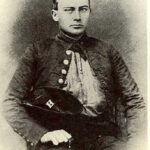

Robert Smalls stands among the most remarkable figures of the American Civil War. Born into slavery, he transformed himself into a Union war hero, naval officer, and later a statesman – all through a combination of intelligence, nerve, determination, and moral clarity. His story is not only dramatic but represents one of the clearest examples of personal agency reshaping history during the war. Join us as we explore the story of this incredible individual.
(If you are traveling in Virginia, consider joining us for a Civil War Battlefield Tour.)

Enslavement and Early Life in Charleston
Robert Smalls was born enslaved in 1839 in Beaufort, South Carolina. As a teenager, he was hired out to work in Charleston, where he gained experience on the city’s busy waterfront. There, Smalls learned seamanship and navigation – skills that would later prove decisive. By his early twenties, he was working aboard the CSS Planter, a Confederate transport ship used to move troops, supplies, and artillery around Charleston Harbor.
Although enslaved, Smalls effectively served as the ship’s pilot, responsible for navigating the dangerous harbor channels and signaling Confederate forts. This role gave him intimate knowledge of Confederate defenses, signal codes, and patrol schedules. At the same time, Smalls remained legally someone’s property, unable to secure freedom for himself, his wife, or his children through lawful means.

The Seizure of the Planter and Escape to Freedom
In the early hours of May 13, 1862, Smalls acted. While the ship’s white officers were ashore, Smalls and a small group of enslaved crewmen took control of the Planter. Wearing the captain’s straw hat to avoid suspicion, Smalls guided the vessel past multiple Confederate forts, correctly using whistle signals and light patterns. Once clear of the harbor, he raised a white flag and surrendered the ship to the Union Navy.
The escape was extraordinary, not only because it succeeded, but because Smalls brought with him his family and the families of other crew members, as well as the ship itself and its cargo of artillery. The event was widely reported in Northern newspapers and made Smalls instantly famous. Union officials quickly recognized the intelligence value of the information he provided about Charleston’s defenses.
Rather than being treated merely as a curiosity, Smalls was employed by the Union Navy as a pilot. He went on to serve aboard Union vessels operating along the South Carolina coast and participated in multiple naval actions. In 1863, Smalls piloted the Planter – now a Union ship – during an engagement near Secessionville. When the white captain abandoned the vessel under fire, Smalls took command and safely brought the ship to safety. For his actions, he became one of the first Black men to receive the pay of a naval captain, a significant precedent during the war.
Advocacy, Leadership, and the Fight for Black Enlistment
Smalls also became an outspoken advocate for Black enlistment. He traveled to Washington, D.C., where he met with President Abraham Lincoln and Secretary of War Edwin Stanton, urging the federal government to allow African American soldiers to fight. His advocacy helped pave the way for the formation of United States Colored Troops, fundamentally changing the Union war effort and the future of the nation.

From War Hero to Statesman
After the war, Smalls returned to Beaufort, where he purchased the home of his former enslaver; this was a symbolic reversal only made possible by emancipation. He entered politics during Reconstruction and was elected to the South Carolina legislature and later to the U.S. House of Representatives, where he served multiple terms. In Congress, Smalls advocated for civil rights, public education, and equal access to public transportation.
Throughout his life, Smalls remained committed to the principles that guided his wartime actions: freedom, citizenship, and dignity. He rejected the notion that formerly enslaved people should be passive recipients of liberty. Instead, his life demonstrated that freedom could be seized, defended, and shaped through action.
Robert Smalls died in 1915, having lived long enough to see both the promise and the retreat of Reconstruction. While later generations attempted to marginalize his achievements, modern scholarship has restored his place as a central figure in Civil War history. He was not simply a symbol of emancipation, but an active architect of it: someone who altered the course of the war through courage and competence.
Smalls’s story reminds us that the Civil War was not only decided by generals and armies, but by individuals who understood what was at stake and acted decisively. His life stands as one of the clearest examples of moral courage in American history and one of the most compelling human stories of the war.
Take your explorations of Civil War history further with a Battlefield Tour in Virginia.