
Most people imagine Santa Claus as a plump, bearded gift-bringer who dresses in red and rides a sleigh from the North Pole. Some assume this image was created by 20th-century Christmas advertising, but the real architect of the modern Santa was a Civil War–era political cartoonist: Thomas Nast, one of the most influential illustrators in American history.
During the 1860s, Nast used his platform at Harper’s Weekly to craft a new, distinctly American version of Santa Claus – one that boosted Union morale during the war and eventually became the worldwide standard. Santa, as we recognize him today, was born not in a department store or marketing campaign, but in the shadow of the Civil War.
Continue reading to discover this curious piece of Civil War history. And if you’d like to explore Civil War battlefields in the company of expert guides, consider booking one of our Civil War Battlefield Tours in Virginia.

Santa Before Nast
Before Thomas Nast picked up his pen, Santa’s image was far from settled. European traditions portrayed St. Nicholas, or Sinterklaas, as a tall, bishop-like figure. Even the beloved 1823 poem “A Visit from St. Nicholas” – with its “jolly old elf” and magical reindeer – left Santa’s appearance open to interpretation. Illustrators experimented widely. Some drew him thin, others small; some kept the bishop’s robes, others dressed him like a fur-clad woodsman.
There was no single, universally recognized Santa Claus. That would change during the Civil War, when a young New York illustrator reimagined the figure for a nation in crisis.
Thomas Nast and Harper’s Weekly
Thomas Nast was born in Germany, immigrated to the United States as a child, and rose to prominence as a political cartoonist. By the time of the Civil War, he was firmly pro-Union and anti-slavery, and his work for Harper’s Weekly gave him extraordinary reach. The magazine was one of the most widely read publications of the 1860s, and its illustrations shaped how civilians understood the war.
Each Christmas, Harper’s Weekly produced themed covers – and Nast seized these opportunities to blend festive spirit with political symbolism. Through these holiday illustrations, he found a way to speak to both soldiers at the front and families at home. Santa Claus became a figure of national unity.
“Santa in Camp”: Santa Joins the Union Army
Nast’s most famous Civil War Christmas image appeared in the January 3, 1863 issue of Harper’s Weekly. Titled “Santa Claus in Camp,” the engraving shows Santa visiting Union soldiers on Christmas Eve. He rides in on a sleigh drawn by reindeer, handing out gifts and cheering the men with his presence.
Here, for the first time, we see many elements of the modern Santa:
- His plump, jolly face
- His full white beard
- His fur-trimmed coat
- His playful, benevolent manner
But Nast also used Santa as political commentary. In this drawing, Santa wears a stars-and-stripes outfit and holds up a puppet of Jefferson Davis, the Confederate president, hanging from a string – a symbolic gesture that left no doubt where his loyalties lay.
For Union soldiers suffering through winter camps, the image was a powerful morale booster. Abraham Lincoln reportedly told visitors that Nast’s illustrations were “the best recruiting sergeant the North ever had.”
Santa Claus – beloved, familiar, and now patriotic – became part of the Union cause.
Building a Legend: Santa’s Workshop, Lists, and the North Pole
Nast continued drawing Christmas images for decades, especially during and after the war. Each illustration added new details to Santa’s story.
In “Santa Claus and His Works” (1863), Nast introduced:
- Santa’s toy workshop
- The idea of elves assisting him
- The “naughty or nice” list
- The tradition of Santa delivering gifts on Christmas Eve
In other illustrations, he expanded on Santa’s domestic life, depicting his home, his workroom, and his methods of gift delivery.
Crucially, Nast later placed Santa’s home at the North Pole. This decision was not just whimsical: it made Santa a figure belonging to no one nation. After a divisive war, Nast was helping recast Santa from a Union symbol into a universal one – a character that all Americans, North and South, could embrace.
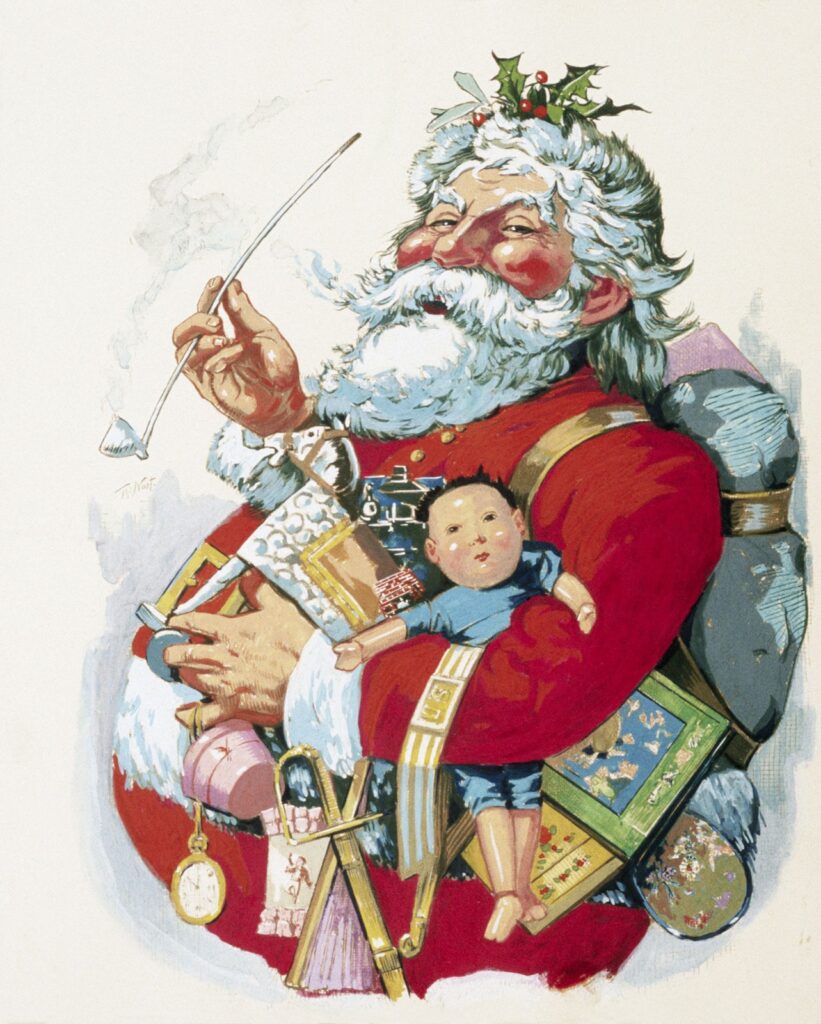
Finally, in 1881, Nast published “Merry Old Santa Claus,” the image now considered the definitive portrait of Santa. Nearly every iconic detail of the modern Santa appears in this engraving. Round, cheerful, fur-clad, and unmistakably kind, Nast’s Santa became the template for all later depictions.
A Civil War Legacy That Lives On
Thomas Nast helped heal a nation with his ever-popular illustrations. During the war, his Santa reassured soldiers that home was still thinking of them. After the war, his evolving illustrations created a shared cultural symbol that was capable of bridging former divisions.
He expanded Santa into a figure of joy, generosity, and national unity, and his imagery shaped every depiction that followed, from magazine covers to early advertising and eventually television and film.
When children today picture Santa Claus, they are, in many ways, seeing the world through the eyes of a Civil War–era illustrator. Thomas Nast’s Civil War illustrations not only standardized Santa’s appearance but also transformed him into a symbol of hope and generosity.
His work reminds us that even in times of conflict, ordinary people sought ways to preserve joy and connection, and in doing so, they created traditions that endure to this day.
Now, take your exploration of Civil War history to the next level with a Battlefield Tour in Virginia.